
Johnson City Previous Residents by Era
Different sources answer different parts of a Johnson City previous-residents question. A deed follows an interest in land. A directory is a time-stamped contact or address clue. Census pages can show a household together, while newspapers and probate records can explain a move, death, or transfer to heirs. The source dates below are the local coverage identified in the research. They are not promises that every record is indexed online or that every address was used in the same form for the full period.
| Source | Years | Where held | What it shows |
|---|---|---|---|
| Deed Book A and Watauga land material | 1775-1782 | Washington County Archives digital index and downloads | Early land indentures, trustees, grants, and patents |
| Washington deed-index microfilm | 1783-1900 | TSLA, microfilm, and interlibrary-loan routes | Grantor and grantee index entries with a book/page trail |
| County deeds, Books 15-20 | 1815-1836, with series-specific overlaps | Archives microfilm inventory | Deed text and legal descriptions |
| Johnson City directories | 1908/09-1935 with gaps; selected later years through 1992 | JCPL, TSLA, and licensed collections | Address, household contact, and dated directory clues |
| Federal census and Press archive | Census 1830-1880 and 1900-1950 locally identified; Press indexed from 1934 | NARA, library resources, TSLA, and JCPL | Household detail, life events, notices, and names |
For a recent Johnson City transfer, begin with the parcel record and the Register. For an older address, the counter, Washington County Archives, TSLA, and the Tennessee Room become more important. No verified modern online Register index cutoff was located, so ask the Register which years and images are available before relying on a browser search.
Start a Johnson City Previous Residents Trail
Save the current parcel identifiers before tracing a name. The Tennessee Property Assessment Data search can normalize a property address, owner spelling, parcel number, subdivision or lot, and sale-date clue. Washington County's map viewer also accepts a property ID, address, or owner. The situs address is the physical parcel location. An owner mailing address is where a tax notice goes, and it may be outside Johnson City. Neither field by itself proves a person lived at the address.
Keep the legal description for the Johnson City parcel, map and group, parcel number, lot or subdivision, and current owner together in a research note. The tax roll is set as of January 1, so an ownership change during the year can appear later than the deed recording date. That timing difference does not make either source wrong. It tells you why the assessor record and a recorded instrument may show different names while the address trail is being rebuilt.
The Tennessee Property Assessment Data search exposes Johnson City-area address, owner, parcel, subdivision, classification, and sale-date searches for Washington County. Its result is a starting identifier, not a household roster.
Trace Johnson City Previous Residents Through Deeds
The Washington County Register of Deeds serves the Johnson City area from the Historic Courthouse in Jonesborough and keeps deeds, trusts, mortgages, liens, plats, leases, powers of attorney, and related instruments. The official Register page describes the office and its public land-record function, but does not publish a confirmed browser grantor/grantee index, field list, image-access rule, or online start year. Use the counter route, then the Archives and TSLA for earlier material. Ask the Register for the online cutoff rather than guessing one from a search screen.
- Bring the current parcel identifiers, legal description, situs address, and owner from the assessment record.
- Ask the Register for help locating the current owner's purchase instrument by name and approximate year.
- Record the grantor, grantee, recording date, book or document reference, consideration, and legal description.
- Read the prior-deed reference, then search the seller as the earlier grantee and repeat the process backward.
- Compare legal description, map, group, parcel, lot, and acreage at every link before connecting two records.
Use the Washington County Register of Deeds office information to confirm Johnson City-area counter access. Recording stops at 4:00 even though the published office day continues to 4:30, an important practical detail when a deed search and a recording visit overlap.
See the Washington County Register of Deeds before using a Johnson City land-record trail.
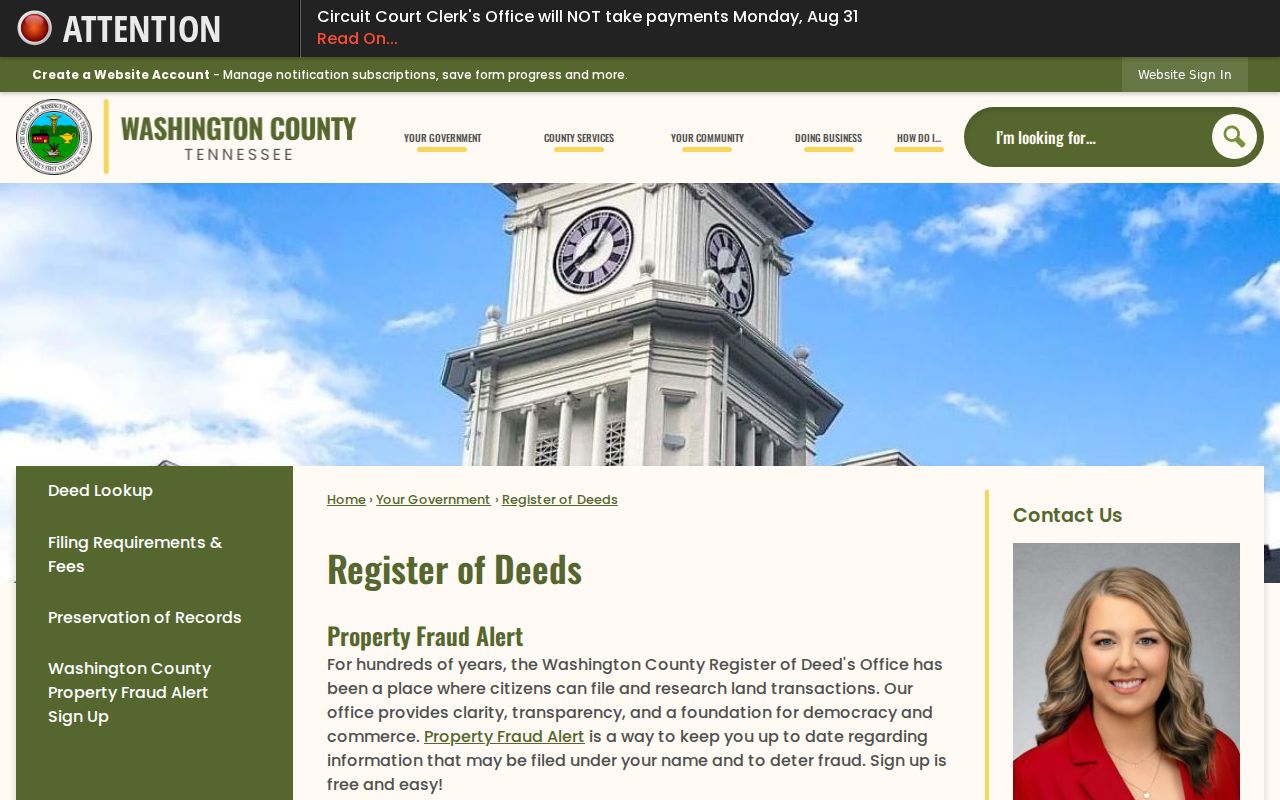
The Register is the official place to confirm a Johnson City instrument and its copy options when an address history reaches beyond information available through a property search.
Terms for Johnson City Past Residents
The terms in a deed index describe a property transaction, not a complete list of people who lived at an address. Reading them correctly prevents a common error: assuming that a legal owner and every member of a household are the same thing. An older instrument may omit a familiar street number entirely, which is why the land description and prior-deed reference matter so much in Johnson City research.
- Grantor
- The person or entity transferring an interest in the property.
- Grantee
- The person or entity receiving that interest. In a backward chain, an earlier grantor may be found as the prior grantee.
- Chain of title
- The sequence of recorded property-interest transfers connected by matching legal descriptions and references.
- Legal description
- The land-identifying wording in a deed, such as lot, block, acreage, map reference, or boundary description. It is more durable than a street label.
If a Johnson City transfer names an heir, spouse, trust, or business entity, preserve the exact form. Probate files, death notices, and Secretary of State records can sometimes clarify a branch, but they should be used to test the deed trail, not to fill a missing link by assumption.
Johnson City Past Residents Before Street Numbers
Deed Book A is a distinctive early endpoint for a land-history search. The Washington County Archives Deed Book A collection provides digital index downloads for material dated 1775-1782. It includes Watauga and Nolichucky settlement transactions, trustee deeds, Cherokee-settler indentures, land patents, and North Carolina grants. The material predates modern city boundaries and modern street addressing, so it cannot be searched as if it were a Johnson City street directory.
Washington County was organized in 1777, and research identifies deeds from 1782, with a deed index from 1783. Those records form an early Johnson City-area trail. TSLA also lists WPA index work for deeds and mortgages, marriages, wills, estate settlements, court minutes, and tax lists. For very early links, identify the tract, settlement wording, grant, or trustee first. Then compare it with later legal descriptions rather than trying to force a modern address onto a record that never used one.
Washington County Archives has reported continuing Johnson City-area series-by-series access work, including digital Deed Book A indexing, marriage-index work, and estate and guardianship material opened for research. That progress does not mean every old record is online. It does identify the Archives as a practical next contact after a web search stops, alongside TSLA microfilm and the Tennessee Room.
Johnson City Past Residents in Directories and Census
Owners are only one layer of a past-residents search. Johnson City directories can place a named household contact at a printed address near a directory date, and released census schedules can add age, relationship, and household composition. The directory collections themselves are described with year gaps and access limits in the Johnson City city directories collection. Use the two sources together instead of expecting either one to answer every address question.
- Copy the directory name, street form, household notation, volume year, page, and abbreviation key.
- Check the closest available directory year and preserve any gap in the collection timeline.
- Pair the entry with the nearest released census and compare address, initials, age, relationship, and place.
- Test a move or ownership change with the deed chain, tax record, or an item in the Press archive.
- Record whether each item is a library database result, microfilm image, shelf volume, archive document, or official index.
Johnson City local research identifies Washington County census material for 1830-1880 and 1900-1950. Federal census release follows a 72-year schedule. Directory runs are selective: 1908/09-1935 has known missing years, while the F444.J6A listing names selected later volumes through 1992. Absence in one source is not a final answer about who lived here before.
Johnson City Past Residents at a Trail End
A last appearance in a directory or a deed chain that moves to heirs calls for a different set of records. The Johnson City Public Library describes its Press archive as fully indexed from 1934, with access through the library's on-site computer or Wi-Fi conditions. Obituaries, funeral notices, moves, sales, and civic items can supply a date or relationship to verify elsewhere. Search variants of the surname, initials, street, and funeral-home name when the first result fails.
Johnson City-area probate is handled through the Washington County Clerk and Master and Chancery routes, while the Archives record groups include probate case files and historical county material. A probate file may explain a transfer to heirs; it does not prove that every heir occupied the address. Use it beside the deed and household record, then retain the file or case reference with the rest of the chain.
Johnson City Past Residents and Changed Addresses
Address continuity is often the hard part. Historical material can name Johnson's Depot, Haynesville, or Johnson City, while older county records may use Jonesboro or Jonesborough. Railroad growth and later annexation changed the city setting around older land descriptions. Search those place variants with Washington County and compare the surrounding streets, lot, map, deed reference, and legal description before treating two addresses as the same place.
Johnson City's CityLimits service is updated after annexations and deannexations, and the city parcel service reaches Washington, Sullivan, Carter, and Unicoi counties. A city label on a map can therefore lead to a different county custodian. Exact local street-renumbering and renaming dates were not located in the research. Old plats, directory volumes, city ordinances, and map sheets need to be checked before converting a historic number to a current address.
Johnson City Past Residents, Permits, and Copies
Johnson City CityView can add a property and building timeline. Its Property Review and permit tools can show parcel or address rows, current and historic property contacts, permit or planning entries, status, date, and work description where indexed. A permit can date a project or connect an address to an owner contact, but it is not proof that a particular person lived there. Current portal coverage start years were not located, so use CityView as a supplement to the deed and directory trail.
For a recorded Johnson City document, official copy pricing can be more useful than a mailed offer. The county's filing and fee information lists in-office copies at $0.25 per page and certified, faxed, mailed, or emailed copies at $1 per page, subject to confirmation with the office. Tennessee's Attorney General documented a deed-copy mailer that offered copies for about $89. Confirm a need and price directly with the Register.
Johnson City Past Residents and Lawful Use
Use a Johnson City address trail for family history, estate or heir questions, understanding a property's history, or checking a record with its custodian. Respect records that are sealed, redacted, or protected by a confidentiality program. Tennessee Safe at Home protects an eligible participant's substitute address in many public-facing contexts, while other restricted records have their own rules. A gap or protected address is not an invitation to seek private household information through another route.
Personal-use boundary. Public records do not authorize monitoring, tracking, threats, or repeated harassment. Tennessee's stalking law, T.C.A. § 39-17-315, applies to conduct involving repeated or continuing harassment.
Correct a Johnson City record through the office that keeps it. The Register, assessor, clerk, archives, and library collections each hold different kinds of evidence. Keeping the source date and citation beside every result supports careful family and property research without turning a historic address search into contact with a living person.